Annual Report 2025 · First edition
Index of Evaluation Institutionalization in the Arab Region
Annual Report 2025 · First edition
Index of Evaluation Institutionalization in the Arab Region
Dr. Anis Ben Brik
2025
© 2026 Arab Observatory for Policy Evaluation Institutionalization. Licence: Creative Commons Attribution 4.0 International (CC BY 4.0).
Suggested citation: Ben Brik, A. (2026). Index of Evaluation Institutionalization in the Arab Region: Annual Report 2025. Arab Observatory for Policy Evaluation Institutionalization.
The findings, interpretations and conclusions expressed in this report are those of the author. Scores are derived from the documented situation in each state as analysed in Ben Brik (2025) and describe institutional arrangements, not the performance of governments.
The designations employed and the presentation of material in this report do not imply the expression of any opinion concerning the legal status of any country or territory or of its authorities.
Acknowledgements
The report was written by Dr. Anis Ben Brik, Principal Investigator of the Index. Hala Al Attar coordinated the project.
The Index was developed from the country assessments and scores published in The Institutionalization of Evaluation in the Middle East and North Africa (Edward Elgar, 2025) and from the national studies in Public Policy Evaluation in the Middle East and North Africa (Policy Press, 2025). The Observatory thanks again the contributors to these volumes, whose country reports served for the development of the Index: Saleh Al-Shumrani and Ahmed Salah (Saudi Arabia); Walaa Ayasrah, Suleiman Majd and Mira Hussein (Jordan); Ayesha AlRifai (Palestine); Mohamed M. El-Fouly and Tamer M. El-Fouly (Egypt); Rachid Essedik (Morocco); Mahmoud Ghouil (Tunisia); and Nashwan Ahmed and Salwa Al Qufaily (Yemen).
The Observatory is grateful to Prof. Dr. Reinhard Stockmann, Founder and Director of the Center for Evaluation (CEval) at Saarland University, for permission to use the framework for the institutionalisation of evaluation employed in the Evaluation Globe, and for reviewing The Institutionalization of Evaluation in the Middle East and North Africa, whose country assessments and scores served for the development of the Index.
Key messages
Symbolic adoption without a legal core
No state in the index has enacted a national evaluation law or decree, and neither parliaments nor supreme audit institutions exercise a formal evaluative function. Five of the 16 indicators score zero in all 11 states, the signature of institutional decoupling between evaluative discourse and binding rules.
Professionalisation drives variation
The consolidating group (Morocco, United Arab Emirates and Oman) is distinguished by professionalisation rather than by political anchoring. Profession-system scores range from 0 to 56.2%, a wider dispersion than in either of the other systems.
An absent demand side
Nine of the 11 states score zero on every indicator of societal system. Evaluation remains a supply-driven, executive-centred instrument with little civic or parliamentary demand for evaluative evidence.
Formal structures ahead of use
The political system scores above the social system in 9 states. Evaluation is organisationally embedded in most executives, and every state records some sectoral spread, yet the use of findings in accountability forums is not institutionalised.
Contents
- Introduction
- 1. Conceptual framework of the Index
- 2. Regional results
- 3. National results
- Annex 1. Indicator coding scales
- Annex 2. Complete indicator data
- References
List of tables
- Table 1. Indicators of the Index and their coding scales
- Table 2. Composite index and sub-dimension scores, by state (per cent)
- Table 3. Mean scores by region (per cent)
- Table 4. Indicator statistics: mean, dispersion and diffusion
- Table 5. Bahrain: summary
- Table 6. Bahrain: sub-dimension and system scores
- Table 7. Bahrain: political system indicators
- Table 8. Bahrain: social system indicators
- Table 9. Bahrain: profession system indicators
- Table 10. Egypt: summary
- Table 11. Egypt: sub-dimension and system scores
- Table 12. Egypt: political system indicators
- Table 13. Egypt: social system indicators
- Table 14. Egypt: profession system indicators
- Table 15. Jordan: summary
- Table 16. Jordan: sub-dimension and system scores
- Table 17. Jordan: political system indicators
- Table 18. Jordan: social system indicators
- Table 19. Jordan: profession system indicators
- Table 20. Kuwait: summary
- Table 21. Kuwait: sub-dimension and system scores
- Table 22. Kuwait: political system indicators
- Table 23. Kuwait: social system indicators
- Table 24. Kuwait: profession system indicators
- Table 25. Morocco: summary
- Table 26. Morocco: sub-dimension and system scores
- Table 27. Morocco: political system indicators
- Table 28. Morocco: social system indicators
- Table 29. Morocco: profession system indicators
- Table 30. Oman: summary
- Table 31. Oman: sub-dimension and system scores
- Table 32. Oman: political system indicators
- Table 33. Oman: social system indicators
- Table 34. Oman: profession system indicators
- Table 35. Palestine: summary
- Table 36. Palestine: sub-dimension and system scores
- Table 37. Palestine: political system indicators
- Table 38. Palestine: social system indicators
- Table 39. Palestine: profession system indicators
- Table 40. Qatar: summary
- Table 41. Qatar: sub-dimension and system scores
- Table 42. Qatar: political system indicators
- Table 43. Qatar: social system indicators
- Table 44. Qatar: profession system indicators
- Table 45. Saudi Arabia: summary
- Table 46. Saudi Arabia: sub-dimension and system scores
- Table 47. Saudi Arabia: political system indicators
- Table 48. Saudi Arabia: social system indicators
- Table 49. Saudi Arabia: profession system indicators
- Table 50. Tunisia: summary
- Table 51. Tunisia: sub-dimension and system scores
- Table 52. Tunisia: political system indicators
- Table 53. Tunisia: social system indicators
- Table 54. Tunisia: profession system indicators
- Table 55. United Arab Emirates: summary
- Table 56. United Arab Emirates: sub-dimension and system scores
- Table 57. United Arab Emirates: political system indicators
- Table 58. United Arab Emirates: social system indicators
- Table 59. United Arab Emirates: profession system indicators
- Table 60. Indicator statistics: mean, dispersion and diffusion
- Table 61. Complete indicator data
List of figures
- Figure 1. Architecture of the index: systems, sub-dimensions and indicators
- Figure 2. Composite index of evaluation institutionalisation, by state
- Figure 3. Political system: institutional anchoring (1A) and evaluation use (1B)
- Figure 4. Political system indicators, by state
- Figure 5. Social system indicators, by state
- Figure 6. Profession system indicators, by state
- Figure 7. Political, social and profession system scores, by state
- Figure 8. Decomposition of the composite index into sub-dimension contributions
- Figure 9. Decoupling between political and social systems (percentage points)
- Figure 10. Political anchoring and professionalisation
- Figure 11. All 16 indicators, by state
- Figure 12. Diffusion of each indicator across states
- Figure 13. Bahrain: sub-dimensions against the regional mean and regional maximum
- Figure 14. Egypt: sub-dimensions against the regional mean and regional maximum
- Figure 15. Jordan: sub-dimensions against the regional mean and regional maximum
- Figure 16. Kuwait: sub-dimensions against the regional mean and regional maximum
- Figure 17. Morocco: sub-dimensions against the regional mean and regional maximum
- Figure 18. Oman: sub-dimensions against the regional mean and regional maximum
- Figure 19. Palestine: sub-dimensions against the regional mean and regional maximum
- Figure 20. Qatar: sub-dimensions against the regional mean and regional maximum
- Figure 21. Saudi Arabia: sub-dimensions against the regional mean and regional maximum
- Figure 22. Tunisia: sub-dimensions against the regional mean and regional maximum
- Figure 23. United Arab Emirates: sub-dimensions against the regional mean and regional maximum
Introduction
Evaluation is a core component of administrative capacity. It is the institutional means by which governments generate systematic evidence on the relevance, effectiveness and efficiency of public interventions, and by which that evidence enters budgeting, policy design and accountability. Where evaluation is institutionalised, it becomes a routine of the state rather than an episodic project financed by development partners.
Comparative research has long documented the uneven institutionalisation of evaluation across countries (Furubo et al., 2002; Jacob et al., 2015). The Arab region, however, has remained largely outside these comparisons. The Index of Evaluation Institutionalization in the Arab Region addresses this gap. It asks three questions: how far evaluation is institutionalised in the political, social and professional systems of Arab League states; which components of institutionalisation account for the differences between states; and what the resulting configurations imply for evaluation policy and public administration reform.
This report presents the first edition of the Index, a scored comparative measurement of the institutionalisation of public policy evaluation in 11 Arab League states. Drawing on the three-system framework of the Evaluation GLOBE project, the index codes 16 indicators of institutional anchoring, evaluation use, societal system and professionalisation, and aggregates them into a composite score expressed as a percentage of the theoretical maximum.
1. Conceptual framework of the Index
A. Architecture of the index
The index conceives institutionalisation as the process by which evaluation acquires rules, organisations, routines and shared expectations that give it stability beyond individual projects and actors. Organisational institutionalism reminds us that formal structures may be adopted for their legitimacy rather than their technical efficiency, and may therefore remain decoupled from practice (Meyer & Rowan, 1977). Isomorphic pressures, whether coercive, mimetic or normative, can spread evaluation units and policies without the capabilities that make them effective (DiMaggio & Powell, 1983; Pritchett et al., 2013).
Following the Evaluation GLOBE project (Stockmann et al., 2020), institutionalisation is observed in three systems. In the political system, evaluation is anchored in laws, decrees, organisational units and the audit function, and is used by parliament and across policy sectors. In the social system, it is known, discussed, published and demanded by citizens and civil society. In the profession system, it rests on academic education, professional communication, voluntary organisations for professional evaluation (VOPEs) and codified norms. Evaluation systems in this sense are configurations of supply and demand for evaluative knowledge (Leeuw & Furubo, 2008), and their use depends on the organisational and political conditions in which findings are received (Weiss, 1998).
Political system
- National evaluation laws and strategies
- National decrees on evaluation
- Organisational embedding
- Evaluation role of the supreme audit institution
- Parliamentary use of evaluation
- Sectoral spread of evaluation
- Scope of evaluation practice
Social system
- Use of evaluation by civil society
- Public knowledge of evaluation
- Media and public discourse
- Public availability of evaluation reports
- Civic demand for evaluation
Profession system
- Academic education in evaluation
- Professional communication and exchange
- Organisation of the profession (VOPEs)
- Professional norms and standards
Reading the figure
The composite aggregates four sub-dimensions with equal weight. The political system contributes two sub-dimensions and seven indicators, the social system one sub-dimension and five indicators, and the profession system one sub-dimension and four indicators.
B. Indicators and coding scales
Table 1
Indicators of the Index and their coding scales
| Sub-dimension | Indicator | Scale |
|---|---|---|
| Institutional anchoring | National evaluation laws and strategies | 0 = absent; 1 = present |
| Institutional anchoring | National decrees on evaluation | 0 = absent; 1 = present |
| Institutional anchoring | Organisational embedding | 0 = absent; 0.5 = partial; 1 = fully established |
| Institutional anchoring | Evaluation role of the supreme audit institution | 0 = absent; 1 = present |
| Evaluation use | Parliamentary use of evaluation | 0 = absent; 0.5 = partial; 1 = fully established |
| Evaluation use | Sectoral spread of evaluation | 0 = absent; 0.5 = partial; 1 = fully established |
| Evaluation use | Scope of evaluation practice | 0 = absent; 0.5 = partial; 1 = fully established |
| Societal system | Use of evaluation by civil society | 0 to 1 in steps of 0.25 |
| Societal system | Public knowledge of evaluation | 0 to 1 in steps of 0.25 |
| Societal system | Media and public discourse | 0 to 1 in steps of 0.25 |
| Societal system | Public availability of evaluation reports | 0 to 1 in steps of 0.25 |
| Societal system | Civic demand for evaluation | 0 to 1 in steps of 0.25 |
| Professionalisation | Academic education in evaluation | 0 none; 0.25 non-academic training; 0.5 single academic course; 0.75 minor subject; 1 major subject |
| Professionalisation | Professional communication and exchange | 0 none; 0.25 exchange in another discipline; 0.5 open media; 0.75 regular publication; 1 academic journals |
| Professionalisation | Organisation of the profession (VOPEs) | 0 none; 0.25 open network; 0.5 formalised network; 0.75 small organisation; 1 large formalised organisation |
| Professionalisation | Professional norms and standards | 0 none; 0.25 informal; 0.5 self-commitment; 0.75 endorsed rules; 1 obligatory standards and certification |
Source: Ben Brik (2025), Index of Evaluation Institutionalization in the Arab Region, first edition.
C. Data collection and coding
The first edition covers 11 states: six in the Gulf, two in the Levant and three in North Africa. Each of the 16 indicators is coded on a common scale from 0 (absent) to 1 (fully institutionalised) on the basis of the documented situation in each state, as analysed in the country chapters of Ben Brik (2025). Binary indicators take the values 0 or 1; three-level indicators take 0, 0.5 or 1; five-level indicators move in steps of 0.25.
D. Calculation of the index
Indicators are averaged into four sub-dimensions: institutional anchoring (1A, four indicators) and evaluation use (1B, three indicators) in the political system, societal system (2A, five indicators) in the social system, and professionalisation (3A, four indicators) in the profession system. The composite index is the unweighted mean of the four sub-dimensions; the political system score is the mean of and 1B. States are grouped as consolidating (22 per cent and above), emerging (14 to 22 per cent) and nascent (below 14 per cent).
E. Reading and using the results
Scores are expressed as percentages of the theoretical maximum of institutionalisation, so that 100 per cent would denote a fully institutionalised evaluation system on every indicator. Indicators should be read together: organisational embedding without legal anchoring, for example, signals a different configuration from the reverse. Indicators that score zero in a state identify the components that evaluation policy should address first. Small differences between states carry little substantive weight at the low score levels observed in this edition, and the index describes institutional arrangements rather than the performance of governments.
(i) Anchor evaluation in law or regulation that specifies obligations to evaluate major programmes, to publish reports and to issue management responses. (ii) Assign evaluative mandates to supreme audit institutions and parliamentary committees, so that evaluation feeds horizontal accountability. (iii) Institutionalise the publication of evaluation reports and management responses to create the conditions for societal system and civic demand. (iv) Support the professionalisation pathway through degree programmes, professional journals and VOPEs, and develop national or regional standards and competency frameworks. (v) Build evaluation into budgeting and planning cycles, so that use becomes a routine of public management rather than an exception.
2. Regional results
A. Overview and composite results
Composite scores are low in absolute terms and compressed across states. The most institutionalised evaluation system reaches 25.6% of the theoretical maximum, and the regional mean is 16.6%. The distance to full institutionalisation is therefore considerable everywhere, and the differences between states should be read as differences in the early stages of institution building.
Reading the figure
Scores range from 10.5% to 25.6%. 3 states form the consolidating group (Morocco, United Arab Emirates and Oman), 3 the emerging group (Qatar, Bahrain and Saudi Arabia) and 5 the nascent group (Kuwait, Egypt, Tunisia, Jordan and Palestine). Every state lies below one third of the theoretical maximum, which places the region at an early stage of institution building. Use the controls to filter by region or to display any sub-dimension.
Table 2
Composite index and sub-dimension scores, by state (per cent)
| State | Region | Institutional anchoring | Evaluation use | Societal system | Professionalisation | Political system | Composite index | Group |
|---|---|---|---|---|---|---|---|---|
| Morocco | North Africa | 13.0 | 33.0 | 0.0 | 56.2 | 23.0 | 25.6 | Consolidating |
| United Arab Emirates | Gulf | 25.0 | 33.0 | 0.0 | 43.8 | 29.0 | 25.4 | Consolidating |
| Oman | Gulf | 13.0 | 33.0 | 0.0 | 43.8 | 23.0 | 22.4 | Consolidating |
| Qatar | Gulf | 13.0 | 33.0 | 0.0 | 25.0 | 23.0 | 17.8 | Emerging |
| Bahrain | Gulf | 13.0 | 17.0 | 25.0 | 12.5 | 15.0 | 16.9 | Emerging |
| Saudi Arabia | Gulf | 13.0 | 33.0 | 0.0 | 12.5 | 23.0 | 14.6 | Emerging |
| Kuwait | Gulf | 13.0 | 17.0 | 25.0 | 0.0 | 15.0 | 13.8 | Nascent |
| Egypt | North Africa | 13.0 | 33.0 | 0.0 | 6.2 | 23.0 | 13.1 | Nascent |
| Tunisia | North Africa | 13.0 | 17.0 | 0.0 | 18.8 | 15.0 | 12.2 | Nascent |
| Jordan | Levant | 0.0 | 17.0 | 0.0 | 25.0 | 8.0 | 10.5 | Nascent |
| Palestine | Levant | 0.0 | 17.0 | 0.0 | 25.0 | 8.0 | 10.5 | Nascent |
| Regional mean | 11.7 | 25.7 | 4.5 | 24.4 | 18.6 | 16.6 |
Note. Values in per cent of the theoretical maximum, as published in Ben Brik (2025). Composite = mean of the four sub-dimensions; political system = mean of and 1B. Groups: consolidating ≥ 22; emerging 14–22; nascent < 14.
Reading the table
The table reports the four sub-dimensions from which the composite is computed. Societal system is zero in nine states, professionalisation varies most, and institutional anchoring never exceeds 25 per cent. The regional mean row provides the benchmark used in the state profiles.
B. Results by system
The political system records a regional mean of 18.6%. Institutional anchoring (1A, mean 11.7%) rests almost entirely on organisational embedding: no state has a national evaluation law, strategy or decree, and supreme audit institutions nowhere exercise a formal evaluative mandate. Evaluation use (1B, mean 25.7%) reflects the spread of evaluation across policy sectors and, in 6 states, a broader scope of evaluative practice; parliaments do not use evaluation in any state.
Reading the figure
Evaluation use (mean 25.7%) exceeds institutional anchoring (mean 11.7%) in most states: evaluation is practised across sectors more than it is mandated by binding rules. United Arab Emirates records full organisational embedding; Jordan and Palestine record none.
Reading the figure
Four of the seven political indicators score zero in every state: national laws and strategies, national decrees, the evaluation role of the supreme audit institution and parliamentary use. The political system therefore rests on organisational embedding, sectoral spread and scope of practice.
The social system is the weakest component of institutionalisation, with a regional mean of 4.5%. Only Bahrain and Kuwait record any societal system, at a uniform 25 per cent on each of the five indicators. Elsewhere, evaluation is not used by civil society, not discussed in the media, not published systematically and not demanded by citizens. In the terms of the evaluation use literature, findings lack the audiences and arenas in which evidence acquires political salience.
Reading the figure
Societal system is confined to Bahrain and Kuwait, each scoring 25 per cent on all five indicators. The uniformity of these scores points to a limited but generalised public presence of evaluation rather than to a developed civic demand.
Professionalisation records a regional mean of 24.4% and the widest dispersion of the three systems, from 0 to 56.2%. Academic education in evaluation is the most developed indicator, reaching the full score in Morocco, United Arab Emirates, Oman and Qatar. Professional communication is strongest in United Arab Emirates, Oman and Jordan. Organised VOPEs exist in Morocco, Jordan and Palestine, and no state has adopted codified professional standards or certification.
Reading the figure
Academic education is the leading component of professionalisation, while professional norms score zero everywhere. Morocco combines full academic education with the only fully developed VOPE in the index, which accounts for its leading composite position.
C. Configurations across systems and indicators
Read together, the three systems describe a common configuration: formal structures in the executive, a partially developed profession and an absent demand side. The decomposition of the composite shows that the leading states owe their position to professionalisation; the gap between the political and social systems shows the extent of decoupling between executive structures and societal uptake; and the coverage of indicators shows which components of institutionalisation are missing across the entire region.
Reading the figure
The profession system shows the widest range between states (0 to 56.2%), the political system a narrower range (8.0% to 29.0%) and the social system the narrowest (0 to 25 per cent). Differences in composite scores are therefore driven primarily by professionalisation.
Reading the figure
Each segment shows a sub-dimension score divided by four, so that segments sum to the composite. Professionalisation contributes 14.1 points to the composite of Morocco, more than any other sub-dimension in any state.
Reading the figure
The political system exceeds the social system in 9 states, by up to 29.0 points. Only Bahrain and Kuwait show the reverse, because societal system is recorded there while political anchoring is weaker. The gap is an indicator of decoupling between executive structures and the social uptake of evaluation.
Reading the figure
States with similar political system scores differ widely in professionalisation: at a political score of 23 per cent, professionalisation ranges from 6.2% to 56.2%. Political anchoring is thus a weak predictor of professional development. Change the axes to explore other pairs of measures.
Reading the figure
The heatmap shows the full coding. Columns without shading identify the components missing across the region; rows show each state’s configuration. Select a state or an indicator to highlight it.
Reading the figure
Sectoral spread is the only indicator present in all 11 states; organisational embedding is present in nine. Five indicators are absent everywhere, and societal indicators are present in two states only. The profile of diffusion confirms an executive-centred pattern of institutionalisation.
Table 3
Mean scores by region (per cent)
| Region | Institutional anchoring | Evaluation use | Societal system | Professionalisation | Composite index | n |
|---|---|---|---|---|---|---|
| Gulf | 15.0 | 27.7 | 8.3 | 22.9 | 18.5 | 6 |
| Levant | 0.0 | 17.0 | 0.0 | 25.0 | 10.5 | 2 |
| North Africa | 13.0 | 27.7 | 0.0 | 27.1 | 16.9 | 3 |
Note. Unweighted means of state scores.
Reading the table
Unweighted regional means should be read with caution given the small number of states per region, particularly the two Levant states. The Gulf records the only societal system in the index; North Africa records the highest mean professionalisation.
Table 4
Indicator statistics: mean, dispersion and diffusion
| Indicator | Sub-dimension | Mean | Standard deviation | States above zero |
|---|---|---|---|---|
| National evaluation laws and strategies | Institutional anchoring | 0.0 | 0.0 | 0 of 11 |
| National decrees on evaluation | Institutional anchoring | 0.0 | 0.0 | 0 of 11 |
| Organisational embedding | Institutional anchoring | 45.5 | 25.7 | 9 of 11 |
| Evaluation role of the supreme audit institution | Institutional anchoring | 0.0 | 0.0 | 0 of 11 |
| Parliamentary use of evaluation | Evaluation use | 0.0 | 0.0 | 0 of 11 |
| Sectoral spread of evaluation | Evaluation use | 50.0 | 0.0 | 11 of 11 |
| Scope of evaluation practice | Evaluation use | 27.3 | 24.9 | 6 of 11 |
| Use of evaluation by civil society | Societal system | 4.5 | 9.6 | 2 of 11 |
| Public knowledge of evaluation | Societal system | 4.5 | 9.6 | 2 of 11 |
| Media and public discourse | Societal system | 4.5 | 9.6 | 2 of 11 |
| Public availability of evaluation reports | Societal system | 4.5 | 9.6 | 2 of 11 |
| Civic demand for evaluation | Societal system | 4.5 | 9.6 | 2 of 11 |
| Academic education in evaluation | Professionalisation | 54.5 | 39.6 | 8 of 11 |
| Professional communication and exchange | Professionalisation | 29.5 | 29.8 | 7 of 11 |
| Organisation of the profession (VOPEs) | Professionalisation | 13.6 | 28.9 | 3 of 11 |
| Professional norms and standards | Professionalisation | 0.0 | 0.0 | 0 of 11 |
Note. Means and population standard deviations in percentage points across the 11 states.
Reading the table
Indicators with a mean of zero and no dispersion carry no discriminating information in this edition but identify the priorities of evaluation policy. Discriminating indicators are concentrated in the profession system.
D. Analysis, observations and recommendations
Three interpretations follow from the evidence. First, the absence of legal anchoring alongside organisational embedding is consistent with institutional decoupling: evaluation units and references to evaluation in planning documents coexist with the absence of binding obligations to evaluate, to publish or to respond to findings (Meyer & Rowan, 1977). Second, the prominence of professionalisation in the leading states suggests a normative pathway of institutionalisation, in which universities, professional networks and VOPEs build capacity ahead of the state (DiMaggio & Powell, 1983). Third, the near-total absence of societal system and parliamentary use indicates that evaluation has not yet become an instrument of horizontal or social accountability.
These configurations carry a risk familiar from the state capability literature: organisations may acquire the forms of evaluation without the functions, and reforms may reward the adoption of evaluation units rather than the use of evaluative evidence (Pritchett et al., 2013). The distance between mandates and use is therefore the central object of evaluation policy in the region.
(i) Anchor evaluation in law or regulation that specifies obligations to evaluate major programmes, to publish reports and to issue management responses. (ii) Assign evaluative mandates to supreme audit institutions and parliamentary committees, so that evaluation feeds horizontal accountability. (iii) Institutionalise the publication of evaluation reports and management responses to create the conditions for societal system and civic demand. (iv) Support the professionalisation pathway through degree programmes, professional journals and VOPEs, and develop national or regional standards and competency frameworks. (v) Build evaluation into budgeting and planning cycles, so that use becomes a routine of public management rather than an exception.
3. National results
This chapter presents the detailed results of each state in a common format: a summary, the scores of the sub-dimensions and systems, a comparison with the regional mean and maximum, the coding of each indicator and observations and proposals derived from the coding.
A. Bahrain
Table 5
Bahrain: summary
| Composite index | Group | Indicators above zero | Region |
|---|---|---|---|
| 16.9% | Emerging | 8 of 16 | Gulf |
Source: Ben Brik (2025), Index of Evaluation Institutionalization in the Arab Region, first edition.
Table 6
Bahrain: sub-dimension and system scores
| Sub-dimension | Score | Regional mean | Regional maximum |
|---|---|---|---|
| Institutional anchoring | 13.0% | 11.7% | 25.0% |
| Evaluation use | 17.0% | 25.7% | 33.0% |
| Societal system | 25.0% | 4.5% | 25.0% |
| Professionalisation | 12.5% | 24.4% | 56.2% |
| Political system | 15.0% | 18.6% | 29.0% |
| Composite index | 16.9% | 16.6% | 25.6% |
Source: Ben Brik (2025), Index of Evaluation Institutionalization in the Arab Region, first edition.
Table 7
Bahrain: political system indicators
| Indicator | Score |
|---|---|
| National evaluation laws and strategies | 0 |
| National decrees on evaluation | 0 |
| Organisational embedding | 0.5 |
| Evaluation role of the supreme audit institution | 0 |
| Parliamentary use of evaluation | 0 |
| Sectoral spread of evaluation | 0.5 |
| Scope of evaluation practice | 0 |
Source: Ben Brik (2025), Index of Evaluation Institutionalization in the Arab Region, first edition.
Table 8
Bahrain: social system indicators
| Indicator | Score |
|---|---|
| Use of evaluation by civil society | 0.25 |
| Public knowledge of evaluation | 0.25 |
| Media and public discourse | 0.25 |
| Public availability of evaluation reports | 0.25 |
| Civic demand for evaluation | 0.25 |
Source: Ben Brik (2025), Index of Evaluation Institutionalization in the Arab Region, first edition.
Table 9
Bahrain: profession system indicators
| Indicator | Score |
|---|---|
| Academic education in evaluation | 0.5 |
| Professional communication and exchange | 0 |
| Organisation of the profession (VOPEs) | 0 |
| Professional norms and standards | 0 |
Source: Ben Brik (2025), Index of Evaluation Institutionalization in the Arab Region, first edition.
Observations and proposals
Bahrain (Gulf) scores 16.9%, above the regional mean, in the emerging group. Its strongest sub-dimension is Societal system (25.0%). It scores above zero on 8 of 16 indicators.
Components at or above the intermediate level: Organisational embedding, Sectoral spread of evaluation and Academic education in evaluation.
Priorities for evaluation policy:
- adopt a legal or regulatory basis that obliges major programmes to be evaluated
- assign an evaluative mandate to the supreme audit institution
- institutionalise the use of evaluation findings by parliamentary committees
- extend evaluation to a broader range of policies and instruments
- support professional exchange through journals and conferences
- support a voluntary organisation for professional evaluation
- develop professional standards and a competency framework with the evaluation community
B. Egypt
Table 10
Egypt: summary
| Composite index | Group | Indicators above zero | Region |
|---|---|---|---|
| 13.1% | Nascent | 4 of 16 | North Africa |
Source: Ben Brik (2025), Index of Evaluation Institutionalization in the Arab Region, first edition.
Table 11
Egypt: sub-dimension and system scores
| Sub-dimension | Score | Regional mean | Regional maximum |
|---|---|---|---|
| Institutional anchoring | 13.0% | 11.7% | 25.0% |
| Evaluation use | 33.0% | 25.7% | 33.0% |
| Societal system | 0.0% | 4.5% | 25.0% |
| Professionalisation | 6.2% | 24.4% | 56.2% |
| Political system | 23.0% | 18.6% | 29.0% |
| Composite index | 13.1% | 16.6% | 25.6% |
Source: Ben Brik (2025), Index of Evaluation Institutionalization in the Arab Region, first edition.
Table 12
Egypt: political system indicators
| Indicator | Score |
|---|---|
| National evaluation laws and strategies | 0 |
| National decrees on evaluation | 0 |
| Organisational embedding | 0.5 |
| Evaluation role of the supreme audit institution | 0 |
| Parliamentary use of evaluation | 0 |
| Sectoral spread of evaluation | 0.5 |
| Scope of evaluation practice | 0.5 |
Source: Ben Brik (2025), Index of Evaluation Institutionalization in the Arab Region, first edition.
Table 13
Egypt: social system indicators
| Indicator | Score |
|---|---|
| Use of evaluation by civil society | 0 |
| Public knowledge of evaluation | 0 |
| Media and public discourse | 0 |
| Public availability of evaluation reports | 0 |
| Civic demand for evaluation | 0 |
Source: Ben Brik (2025), Index of Evaluation Institutionalization in the Arab Region, first edition.
Table 14
Egypt: profession system indicators
| Indicator | Score |
|---|---|
| Academic education in evaluation | 0 |
| Professional communication and exchange | 0.25 |
| Organisation of the profession (VOPEs) | 0 |
| Professional norms and standards | 0 |
Source: Ben Brik (2025), Index of Evaluation Institutionalization in the Arab Region, first edition.
Observations and proposals
Egypt (North Africa) scores 13.1%, below the regional mean, in the nascent group. Its strongest sub-dimension is Evaluation use (33.0%). It scores above zero on 4 of 16 indicators.
Components at or above the intermediate level: Organisational embedding, Sectoral spread of evaluation and Scope of evaluation practice.
Priorities for evaluation policy:
- adopt a legal or regulatory basis that obliges major programmes to be evaluated
- assign an evaluative mandate to the supreme audit institution
- institutionalise the use of evaluation findings by parliamentary committees
- publish evaluation reports and management responses to build public knowledge and civic demand
- introduce academic programmes in evaluation
- support a voluntary organisation for professional evaluation
- develop professional standards and a competency framework with the evaluation community
C. Jordan
Table 15
Jordan: summary
| Composite index | Group | Indicators above zero | Region |
|---|---|---|---|
| 10.5% | Nascent | 3 of 16 | Levant |
Source: Ben Brik (2025), Index of Evaluation Institutionalization in the Arab Region, first edition.
Table 16
Jordan: sub-dimension and system scores
| Sub-dimension | Score | Regional mean | Regional maximum |
|---|---|---|---|
| Institutional anchoring | 0.0% | 11.7% | 25.0% |
| Evaluation use | 17.0% | 25.7% | 33.0% |
| Societal system | 0.0% | 4.5% | 25.0% |
| Professionalisation | 25.0% | 24.4% | 56.2% |
| Political system | 8.0% | 18.6% | 29.0% |
| Composite index | 10.5% | 16.6% | 25.6% |
Source: Ben Brik (2025), Index of Evaluation Institutionalization in the Arab Region, first edition.
Table 17
Jordan: political system indicators
| Indicator | Score |
|---|---|
| National evaluation laws and strategies | 0 |
| National decrees on evaluation | 0 |
| Organisational embedding | 0 |
| Evaluation role of the supreme audit institution | 0 |
| Parliamentary use of evaluation | 0 |
| Sectoral spread of evaluation | 0.5 |
| Scope of evaluation practice | 0 |
Source: Ben Brik (2025), Index of Evaluation Institutionalization in the Arab Region, first edition.
Table 18
Jordan: social system indicators
| Indicator | Score |
|---|---|
| Use of evaluation by civil society | 0 |
| Public knowledge of evaluation | 0 |
| Media and public discourse | 0 |
| Public availability of evaluation reports | 0 |
| Civic demand for evaluation | 0 |
Source: Ben Brik (2025), Index of Evaluation Institutionalization in the Arab Region, first edition.
Table 19
Jordan: profession system indicators
| Indicator | Score |
|---|---|
| Academic education in evaluation | 0 |
| Professional communication and exchange | 0.75 |
| Organisation of the profession (VOPEs) | 0.25 |
| Professional norms and standards | 0 |
Source: Ben Brik (2025), Index of Evaluation Institutionalization in the Arab Region, first edition.
Observations and proposals
Jordan (Levant) scores 10.5%, below the regional mean, in the nascent group. Its strongest sub-dimension is Professionalisation (25.0%). It scores above zero on 3 of 16 indicators.
Components at or above the intermediate level: Sectoral spread of evaluation and Professional communication and exchange.
Priorities for evaluation policy:
- adopt a legal or regulatory basis that obliges major programmes to be evaluated
- assign an evaluative mandate to the supreme audit institution
- institutionalise the use of evaluation findings by parliamentary committees
- establish evaluation units in ministries or at the centre of government
- extend evaluation to a broader range of policies and instruments
- publish evaluation reports and management responses to build public knowledge and civic demand
- introduce academic programmes in evaluation
- develop professional standards and a competency framework with the evaluation community
D. Kuwait
Table 20
Kuwait: summary
| Composite index | Group | Indicators above zero | Region |
|---|---|---|---|
| 13.8% | Nascent | 7 of 16 | Gulf |
Source: Ben Brik (2025), Index of Evaluation Institutionalization in the Arab Region, first edition.
Table 21
Kuwait: sub-dimension and system scores
| Sub-dimension | Score | Regional mean | Regional maximum |
|---|---|---|---|
| Institutional anchoring | 13.0% | 11.7% | 25.0% |
| Evaluation use | 17.0% | 25.7% | 33.0% |
| Societal system | 25.0% | 4.5% | 25.0% |
| Professionalisation | 0.0% | 24.4% | 56.2% |
| Political system | 15.0% | 18.6% | 29.0% |
| Composite index | 13.8% | 16.6% | 25.6% |
Source: Ben Brik (2025), Index of Evaluation Institutionalization in the Arab Region, first edition.
Table 22
Kuwait: political system indicators
| Indicator | Score |
|---|---|
| National evaluation laws and strategies | 0 |
| National decrees on evaluation | 0 |
| Organisational embedding | 0.5 |
| Evaluation role of the supreme audit institution | 0 |
| Parliamentary use of evaluation | 0 |
| Sectoral spread of evaluation | 0.5 |
| Scope of evaluation practice | 0 |
Source: Ben Brik (2025), Index of Evaluation Institutionalization in the Arab Region, first edition.
Table 23
Kuwait: social system indicators
| Indicator | Score |
|---|---|
| Use of evaluation by civil society | 0.25 |
| Public knowledge of evaluation | 0.25 |
| Media and public discourse | 0.25 |
| Public availability of evaluation reports | 0.25 |
| Civic demand for evaluation | 0.25 |
Source: Ben Brik (2025), Index of Evaluation Institutionalization in the Arab Region, first edition.
Table 24
Kuwait: profession system indicators
| Indicator | Score |
|---|---|
| Academic education in evaluation | 0 |
| Professional communication and exchange | 0 |
| Organisation of the profession (VOPEs) | 0 |
| Professional norms and standards | 0 |
Source: Ben Brik (2025), Index of Evaluation Institutionalization in the Arab Region, first edition.
Observations and proposals
Kuwait (Gulf) scores 13.8%, below the regional mean, in the nascent group. Its strongest sub-dimension is Societal system (25.0%). It scores above zero on 7 of 16 indicators.
Components at or above the intermediate level: Organisational embedding and Sectoral spread of evaluation.
Priorities for evaluation policy:
- adopt a legal or regulatory basis that obliges major programmes to be evaluated
- assign an evaluative mandate to the supreme audit institution
- institutionalise the use of evaluation findings by parliamentary committees
- extend evaluation to a broader range of policies and instruments
- introduce academic programmes in evaluation
- support professional exchange through journals and conferences
- support a voluntary organisation for professional evaluation
- develop professional standards and a competency framework with the evaluation community
E. Morocco
Table 25
Morocco: summary
| Composite index | Group | Indicators above zero | Region |
|---|---|---|---|
| 25.6% | Consolidating | 6 of 16 | North Africa |
Source: Ben Brik (2025), Index of Evaluation Institutionalization in the Arab Region, first edition.
Table 26
Morocco: sub-dimension and system scores
| Sub-dimension | Score | Regional mean | Regional maximum |
|---|---|---|---|
| Institutional anchoring | 13.0% | 11.7% | 25.0% |
| Evaluation use | 33.0% | 25.7% | 33.0% |
| Societal system | 0.0% | 4.5% | 25.0% |
| Professionalisation | 56.2% | 24.4% | 56.2% |
| Political system | 23.0% | 18.6% | 29.0% |
| Composite index | 25.6% | 16.6% | 25.6% |
Source: Ben Brik (2025), Index of Evaluation Institutionalization in the Arab Region, first edition.
Table 27
Morocco: political system indicators
| Indicator | Score |
|---|---|
| National evaluation laws and strategies | 0 |
| National decrees on evaluation | 0 |
| Organisational embedding | 0.5 |
| Evaluation role of the supreme audit institution | 0 |
| Parliamentary use of evaluation | 0 |
| Sectoral spread of evaluation | 0.5 |
| Scope of evaluation practice | 0.5 |
Source: Ben Brik (2025), Index of Evaluation Institutionalization in the Arab Region, first edition.
Table 28
Morocco: social system indicators
| Indicator | Score |
|---|---|
| Use of evaluation by civil society | 0 |
| Public knowledge of evaluation | 0 |
| Media and public discourse | 0 |
| Public availability of evaluation reports | 0 |
| Civic demand for evaluation | 0 |
Source: Ben Brik (2025), Index of Evaluation Institutionalization in the Arab Region, first edition.
Table 29
Morocco: profession system indicators
| Indicator | Score |
|---|---|
| Academic education in evaluation | 1 |
| Professional communication and exchange | 0.25 |
| Organisation of the profession (VOPEs) | 1 |
| Professional norms and standards | 0 |
Source: Ben Brik (2025), Index of Evaluation Institutionalization in the Arab Region, first edition.
Observations and proposals
Morocco (North Africa) scores 25.6%, above the regional mean, in the consolidating group. Its strongest sub-dimension is Professionalisation (56.2%). It scores above zero on 6 of 16 indicators, reaching the full score on academic education in evaluation and organisation of the profession (VOPEs).
Components at or above the intermediate level: Organisational embedding, Sectoral spread of evaluation, Scope of evaluation practice, Academic education in evaluation and Organisation of the profession (VOPEs).
Priorities for evaluation policy:
- adopt a legal or regulatory basis that obliges major programmes to be evaluated
- assign an evaluative mandate to the supreme audit institution
- institutionalise the use of evaluation findings by parliamentary committees
- publish evaluation reports and management responses to build public knowledge and civic demand
- develop professional standards and a competency framework with the evaluation community
F. Oman
Table 30
Oman: summary
| Composite index | Group | Indicators above zero | Region |
|---|---|---|---|
| 22.4% | Consolidating | 5 of 16 | Gulf |
Source: Ben Brik (2025), Index of Evaluation Institutionalization in the Arab Region, first edition.
Table 31
Oman: sub-dimension and system scores
| Sub-dimension | Score | Regional mean | Regional maximum |
|---|---|---|---|
| Institutional anchoring | 13.0% | 11.7% | 25.0% |
| Evaluation use | 33.0% | 25.7% | 33.0% |
| Societal system | 0.0% | 4.5% | 25.0% |
| Professionalisation | 43.8% | 24.4% | 56.2% |
| Political system | 23.0% | 18.6% | 29.0% |
| Composite index | 22.4% | 16.6% | 25.6% |
Source: Ben Brik (2025), Index of Evaluation Institutionalization in the Arab Region, first edition.
Table 32
Oman: political system indicators
| Indicator | Score |
|---|---|
| National evaluation laws and strategies | 0 |
| National decrees on evaluation | 0 |
| Organisational embedding | 0.5 |
| Evaluation role of the supreme audit institution | 0 |
| Parliamentary use of evaluation | 0 |
| Sectoral spread of evaluation | 0.5 |
| Scope of evaluation practice | 0.5 |
Source: Ben Brik (2025), Index of Evaluation Institutionalization in the Arab Region, first edition.
Table 33
Oman: social system indicators
| Indicator | Score |
|---|---|
| Use of evaluation by civil society | 0 |
| Public knowledge of evaluation | 0 |
| Media and public discourse | 0 |
| Public availability of evaluation reports | 0 |
| Civic demand for evaluation | 0 |
Source: Ben Brik (2025), Index of Evaluation Institutionalization in the Arab Region, first edition.
Table 34
Oman: profession system indicators
| Indicator | Score |
|---|---|
| Academic education in evaluation | 1 |
| Professional communication and exchange | 0.75 |
| Organisation of the profession (VOPEs) | 0 |
| Professional norms and standards | 0 |
Source: Ben Brik (2025), Index of Evaluation Institutionalization in the Arab Region, first edition.
Observations and proposals
Oman (Gulf) scores 22.4%, above the regional mean, in the consolidating group. Its strongest sub-dimension is Professionalisation (43.8%). It scores above zero on 5 of 16 indicators, reaching the full score on academic education in evaluation.
Components at or above the intermediate level: Organisational embedding, Sectoral spread of evaluation, Scope of evaluation practice, Academic education in evaluation and Professional communication and exchange.
Priorities for evaluation policy:
- adopt a legal or regulatory basis that obliges major programmes to be evaluated
- assign an evaluative mandate to the supreme audit institution
- institutionalise the use of evaluation findings by parliamentary committees
- publish evaluation reports and management responses to build public knowledge and civic demand
- support a voluntary organisation for professional evaluation
- develop professional standards and a competency framework with the evaluation community
G. Palestine
Table 35
Palestine: summary
| Composite index | Group | Indicators above zero | Region |
|---|---|---|---|
| 10.5% | Nascent | 4 of 16 | Levant |
Source: Ben Brik (2025), Index of Evaluation Institutionalization in the Arab Region, first edition.
Table 36
Palestine: sub-dimension and system scores
| Sub-dimension | Score | Regional mean | Regional maximum |
|---|---|---|---|
| Institutional anchoring | 0.0% | 11.7% | 25.0% |
| Evaluation use | 17.0% | 25.7% | 33.0% |
| Societal system | 0.0% | 4.5% | 25.0% |
| Professionalisation | 25.0% | 24.4% | 56.2% |
| Political system | 8.0% | 18.6% | 29.0% |
| Composite index | 10.5% | 16.6% | 25.6% |
Source: Ben Brik (2025), Index of Evaluation Institutionalization in the Arab Region, first edition.
Table 37
Palestine: political system indicators
| Indicator | Score |
|---|---|
| National evaluation laws and strategies | 0 |
| National decrees on evaluation | 0 |
| Organisational embedding | 0 |
| Evaluation role of the supreme audit institution | 0 |
| Parliamentary use of evaluation | 0 |
| Sectoral spread of evaluation | 0.5 |
| Scope of evaluation practice | 0 |
Source: Ben Brik (2025), Index of Evaluation Institutionalization in the Arab Region, first edition.
Table 38
Palestine: social system indicators
| Indicator | Score |
|---|---|
| Use of evaluation by civil society | 0 |
| Public knowledge of evaluation | 0 |
| Media and public discourse | 0 |
| Public availability of evaluation reports | 0 |
| Civic demand for evaluation | 0 |
Source: Ben Brik (2025), Index of Evaluation Institutionalization in the Arab Region, first edition.
Table 39
Palestine: profession system indicators
| Indicator | Score |
|---|---|
| Academic education in evaluation | 0.5 |
| Professional communication and exchange | 0.25 |
| Organisation of the profession (VOPEs) | 0.25 |
| Professional norms and standards | 0 |
Source: Ben Brik (2025), Index of Evaluation Institutionalization in the Arab Region, first edition.
Observations and proposals
Palestine (Levant) scores 10.5%, below the regional mean, in the nascent group. Its strongest sub-dimension is Professionalisation (25.0%). It scores above zero on 4 of 16 indicators.
Components at or above the intermediate level: Sectoral spread of evaluation and Academic education in evaluation.
Priorities for evaluation policy:
- adopt a legal or regulatory basis that obliges major programmes to be evaluated
- assign an evaluative mandate to the supreme audit institution
- institutionalise the use of evaluation findings by parliamentary committees
- establish evaluation units in ministries or at the centre of government
- extend evaluation to a broader range of policies and instruments
- publish evaluation reports and management responses to build public knowledge and civic demand
- develop professional standards and a competency framework with the evaluation community
H. Qatar
Table 40
Qatar: summary
| Composite index | Group | Indicators above zero | Region |
|---|---|---|---|
| 17.8% | Emerging | 4 of 16 | Gulf |
Source: Ben Brik (2025), Index of Evaluation Institutionalization in the Arab Region, first edition.
Table 41
Qatar: sub-dimension and system scores
| Sub-dimension | Score | Regional mean | Regional maximum |
|---|---|---|---|
| Institutional anchoring | 13.0% | 11.7% | 25.0% |
| Evaluation use | 33.0% | 25.7% | 33.0% |
| Societal system | 0.0% | 4.5% | 25.0% |
| Professionalisation | 25.0% | 24.4% | 56.2% |
| Political system | 23.0% | 18.6% | 29.0% |
| Composite index | 17.8% | 16.6% | 25.6% |
Source: Ben Brik (2025), Index of Evaluation Institutionalization in the Arab Region, first edition.
Table 42
Qatar: political system indicators
| Indicator | Score |
|---|---|
| National evaluation laws and strategies | 0 |
| National decrees on evaluation | 0 |
| Organisational embedding | 0.5 |
| Evaluation role of the supreme audit institution | 0 |
| Parliamentary use of evaluation | 0 |
| Sectoral spread of evaluation | 0.5 |
| Scope of evaluation practice | 0.5 |
Source: Ben Brik (2025), Index of Evaluation Institutionalization in the Arab Region, first edition.
Table 43
Qatar: social system indicators
| Indicator | Score |
|---|---|
| Use of evaluation by civil society | 0 |
| Public knowledge of evaluation | 0 |
| Media and public discourse | 0 |
| Public availability of evaluation reports | 0 |
| Civic demand for evaluation | 0 |
Source: Ben Brik (2025), Index of Evaluation Institutionalization in the Arab Region, first edition.
Table 44
Qatar: profession system indicators
| Indicator | Score |
|---|---|
| Academic education in evaluation | 1 |
| Professional communication and exchange | 0 |
| Organisation of the profession (VOPEs) | 0 |
| Professional norms and standards | 0 |
Source: Ben Brik (2025), Index of Evaluation Institutionalization in the Arab Region, first edition.
Observations and proposals
Qatar (Gulf) scores 17.8%, above the regional mean, in the emerging group. Its strongest sub-dimension is Evaluation use (33.0%). It scores above zero on 4 of 16 indicators, reaching the full score on academic education in evaluation.
Components at or above the intermediate level: Organisational embedding, Sectoral spread of evaluation, Scope of evaluation practice and Academic education in evaluation.
Priorities for evaluation policy:
- adopt a legal or regulatory basis that obliges major programmes to be evaluated
- assign an evaluative mandate to the supreme audit institution
- institutionalise the use of evaluation findings by parliamentary committees
- publish evaluation reports and management responses to build public knowledge and civic demand
- support professional exchange through journals and conferences
- support a voluntary organisation for professional evaluation
- develop professional standards and a competency framework with the evaluation community
I. Saudi Arabia
Table 45
Saudi Arabia: summary
| Composite index | Group | Indicators above zero | Region |
|---|---|---|---|
| 14.6% | Emerging | 4 of 16 | Gulf |
Source: Ben Brik (2025), Index of Evaluation Institutionalization in the Arab Region, first edition.
Table 46
Saudi Arabia: sub-dimension and system scores
| Sub-dimension | Score | Regional mean | Regional maximum |
|---|---|---|---|
| Institutional anchoring | 13.0% | 11.7% | 25.0% |
| Evaluation use | 33.0% | 25.7% | 33.0% |
| Societal system | 0.0% | 4.5% | 25.0% |
| Professionalisation | 12.5% | 24.4% | 56.2% |
| Political system | 23.0% | 18.6% | 29.0% |
| Composite index | 14.6% | 16.6% | 25.6% |
Source: Ben Brik (2025), Index of Evaluation Institutionalization in the Arab Region, first edition.
Table 47
Saudi Arabia: political system indicators
| Indicator | Score |
|---|---|
| National evaluation laws and strategies | 0 |
| National decrees on evaluation | 0 |
| Organisational embedding | 0.5 |
| Evaluation role of the supreme audit institution | 0 |
| Parliamentary use of evaluation | 0 |
| Sectoral spread of evaluation | 0.5 |
| Scope of evaluation practice | 0.5 |
Source: Ben Brik (2025), Index of Evaluation Institutionalization in the Arab Region, first edition.
Table 48
Saudi Arabia: social system indicators
| Indicator | Score |
|---|---|
| Use of evaluation by civil society | 0 |
| Public knowledge of evaluation | 0 |
| Media and public discourse | 0 |
| Public availability of evaluation reports | 0 |
| Civic demand for evaluation | 0 |
Source: Ben Brik (2025), Index of Evaluation Institutionalization in the Arab Region, first edition.
Table 49
Saudi Arabia: profession system indicators
| Indicator | Score |
|---|---|
| Academic education in evaluation | 0.5 |
| Professional communication and exchange | 0 |
| Organisation of the profession (VOPEs) | 0 |
| Professional norms and standards | 0 |
Source: Ben Brik (2025), Index of Evaluation Institutionalization in the Arab Region, first edition.
Observations and proposals
Saudi Arabia (Gulf) scores 14.6%, below the regional mean, in the emerging group. Its strongest sub-dimension is Evaluation use (33.0%). It scores above zero on 4 of 16 indicators.
Components at or above the intermediate level: Organisational embedding, Sectoral spread of evaluation, Scope of evaluation practice and Academic education in evaluation.
Priorities for evaluation policy:
- adopt a legal or regulatory basis that obliges major programmes to be evaluated
- assign an evaluative mandate to the supreme audit institution
- institutionalise the use of evaluation findings by parliamentary committees
- publish evaluation reports and management responses to build public knowledge and civic demand
- support professional exchange through journals and conferences
- support a voluntary organisation for professional evaluation
- develop professional standards and a competency framework with the evaluation community
J. Tunisia
Table 50
Tunisia: summary
| Composite index | Group | Indicators above zero | Region |
|---|---|---|---|
| 12.2% | Nascent | 4 of 16 | North Africa |
Source: Ben Brik (2025), Index of Evaluation Institutionalization in the Arab Region, first edition.
Table 51
Tunisia: sub-dimension and system scores
| Sub-dimension | Score | Regional mean | Regional maximum |
|---|---|---|---|
| Institutional anchoring | 13.0% | 11.7% | 25.0% |
| Evaluation use | 17.0% | 25.7% | 33.0% |
| Societal system | 0.0% | 4.5% | 25.0% |
| Professionalisation | 18.8% | 24.4% | 56.2% |
| Political system | 15.0% | 18.6% | 29.0% |
| Composite index | 12.2% | 16.6% | 25.6% |
Source: Ben Brik (2025), Index of Evaluation Institutionalization in the Arab Region, first edition.
Table 52
Tunisia: political system indicators
| Indicator | Score |
|---|---|
| National evaluation laws and strategies | 0 |
| National decrees on evaluation | 0 |
| Organisational embedding | 0.5 |
| Evaluation role of the supreme audit institution | 0 |
| Parliamentary use of evaluation | 0 |
| Sectoral spread of evaluation | 0.5 |
| Scope of evaluation practice | 0 |
Source: Ben Brik (2025), Index of Evaluation Institutionalization in the Arab Region, first edition.
Table 53
Tunisia: social system indicators
| Indicator | Score |
|---|---|
| Use of evaluation by civil society | 0 |
| Public knowledge of evaluation | 0 |
| Media and public discourse | 0 |
| Public availability of evaluation reports | 0 |
| Civic demand for evaluation | 0 |
Source: Ben Brik (2025), Index of Evaluation Institutionalization in the Arab Region, first edition.
Table 54
Tunisia: profession system indicators
| Indicator | Score |
|---|---|
| Academic education in evaluation | 0.5 |
| Professional communication and exchange | 0.25 |
| Organisation of the profession (VOPEs) | 0 |
| Professional norms and standards | 0 |
Source: Ben Brik (2025), Index of Evaluation Institutionalization in the Arab Region, first edition.
Observations and proposals
Tunisia (North Africa) scores 12.2%, below the regional mean, in the nascent group. Its strongest sub-dimension is Professionalisation (18.8%). It scores above zero on 4 of 16 indicators.
Components at or above the intermediate level: Organisational embedding, Sectoral spread of evaluation and Academic education in evaluation.
Priorities for evaluation policy:
- adopt a legal or regulatory basis that obliges major programmes to be evaluated
- assign an evaluative mandate to the supreme audit institution
- institutionalise the use of evaluation findings by parliamentary committees
- extend evaluation to a broader range of policies and instruments
- publish evaluation reports and management responses to build public knowledge and civic demand
- support a voluntary organisation for professional evaluation
- develop professional standards and a competency framework with the evaluation community
K. United Arab Emirates
Table 55
United Arab Emirates: summary
| Composite index | Group | Indicators above zero | Region |
|---|---|---|---|
| 25.4% | Consolidating | 5 of 16 | Gulf |
Source: Ben Brik (2025), Index of Evaluation Institutionalization in the Arab Region, first edition.
Table 56
United Arab Emirates: sub-dimension and system scores
| Sub-dimension | Score | Regional mean | Regional maximum |
|---|---|---|---|
| Institutional anchoring | 25.0% | 11.7% | 25.0% |
| Evaluation use | 33.0% | 25.7% | 33.0% |
| Societal system | 0.0% | 4.5% | 25.0% |
| Professionalisation | 43.8% | 24.4% | 56.2% |
| Political system | 29.0% | 18.6% | 29.0% |
| Composite index | 25.4% | 16.6% | 25.6% |
Source: Ben Brik (2025), Index of Evaluation Institutionalization in the Arab Region, first edition.
Table 57
United Arab Emirates: political system indicators
| Indicator | Score |
|---|---|
| National evaluation laws and strategies | 0 |
| National decrees on evaluation | 0 |
| Organisational embedding | 1 |
| Evaluation role of the supreme audit institution | 0 |
| Parliamentary use of evaluation | 0 |
| Sectoral spread of evaluation | 0.5 |
| Scope of evaluation practice | 0.5 |
Source: Ben Brik (2025), Index of Evaluation Institutionalization in the Arab Region, first edition.
Table 58
United Arab Emirates: social system indicators
| Indicator | Score |
|---|---|
| Use of evaluation by civil society | 0 |
| Public knowledge of evaluation | 0 |
| Media and public discourse | 0 |
| Public availability of evaluation reports | 0 |
| Civic demand for evaluation | 0 |
Source: Ben Brik (2025), Index of Evaluation Institutionalization in the Arab Region, first edition.
Table 59
United Arab Emirates: profession system indicators
| Indicator | Score |
|---|---|
| Academic education in evaluation | 1 |
| Professional communication and exchange | 0.75 |
| Organisation of the profession (VOPEs) | 0 |
| Professional norms and standards | 0 |
Source: Ben Brik (2025), Index of Evaluation Institutionalization in the Arab Region, first edition.
Observations and proposals
United Arab Emirates (Gulf) scores 25.4%, above the regional mean, in the consolidating group. Its strongest sub-dimension is Professionalisation (43.8%). It scores above zero on 5 of 16 indicators, reaching the full score on organisational embedding and academic education in evaluation.
Components at or above the intermediate level: Organisational embedding, Sectoral spread of evaluation, Scope of evaluation practice, Academic education in evaluation and Professional communication and exchange.
Priorities for evaluation policy:
- adopt a legal or regulatory basis that obliges major programmes to be evaluated
- assign an evaluative mandate to the supreme audit institution
- institutionalise the use of evaluation findings by parliamentary committees
- publish evaluation reports and management responses to build public knowledge and civic demand
- support a voluntary organisation for professional evaluation
- develop professional standards and a competency framework with the evaluation community
4. Institutional architecture and gaps
This chapter examines the architecture of institutionalisation: the share of each system in the total of a state, and the gaps between systems.
Key messages
- 9 of 11 states lie on the political–profession edge: no societal system is recorded in them.
- The widest gap separates the profession and social systems in Morocco (56.2 points).
- States with similar composite scores have different architectures.
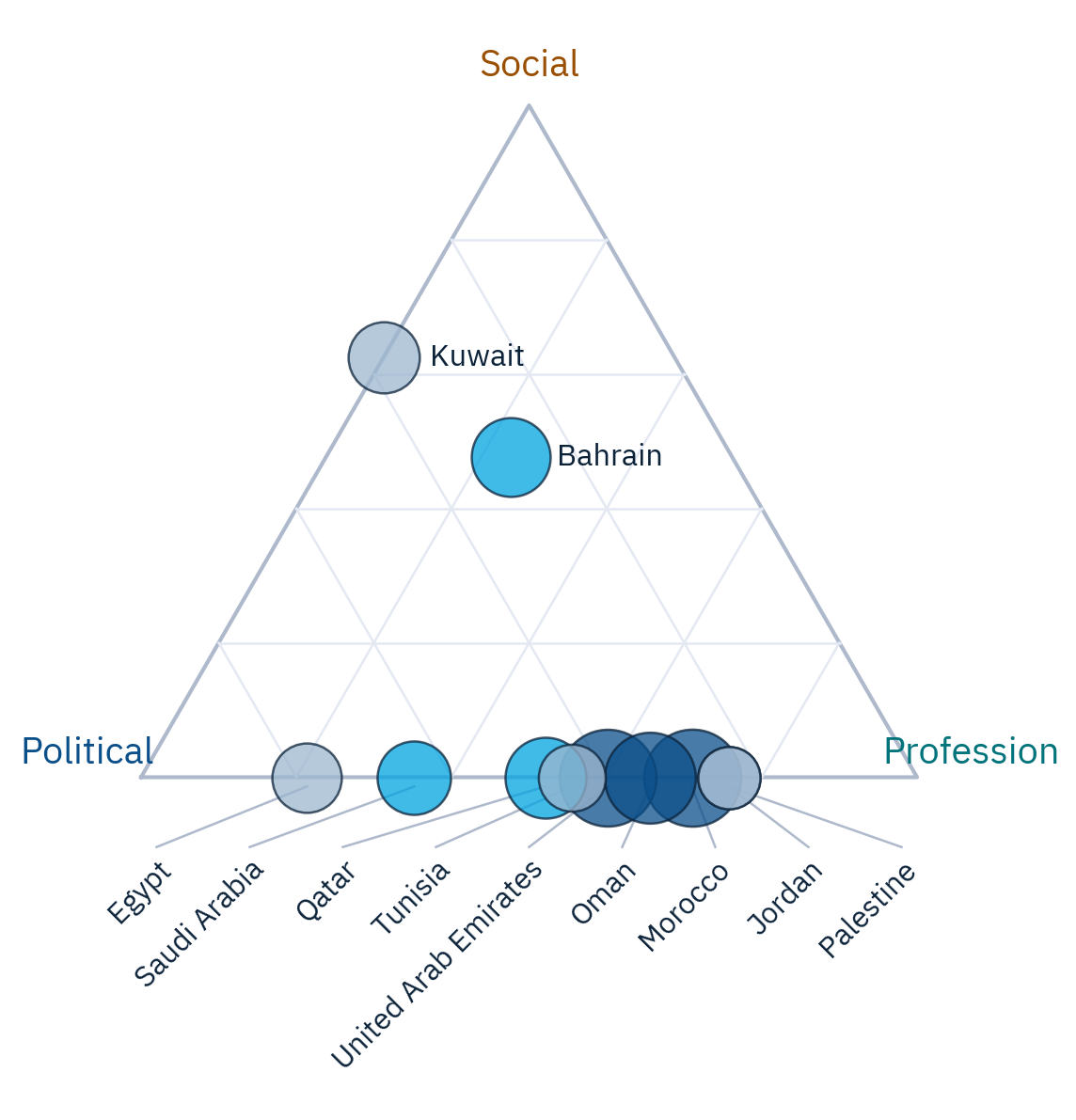
The composite index measures how much evaluation is institutionalised; it does not show how institutionalisation is distributed. The share of each system in the total of a state describes that architecture. In 9 of the 11 states the social system scores zero, so their institutionalisation rests entirely on the political and professional systems; only Bahrain and Kuwait record a societal component, and in both it forms the largest share.
Along the political–profession edge, position separates states in which professional capacity leads from states anchored mainly in the executive. Egypt and Saudi Arabia sit closest to the political pole; Morocco, Jordan and Palestine closest to the profession pole. The pairwise gaps between systems make the imbalance explicit. The largest gap in the region separates the profession and social systems in Morocco (56.2 points), followed by the United Arab Emirates (43.8 points).
The implication is that similar composite scores conceal different institutional problems. A state whose score rests on executive structures requires professional and societal capacity; a state whose score rests on the profession requires anchoring in the state and in its oversight institutions.
The configuration chart places each state by the share of its three systems in its total, with circle area proportional to the composite score. It answers a question the composite cannot: whether institutionalisation rests on the state, on the profession or on society. Most states sit on the lower edge, where the social share is zero.
Source: Ben Brik (2025), Index of Evaluation Institutionalization in the Arab Region, first edition. Framework: Evaluation GLOBE (Stockmann et al., 2020), used with permission.
The table reports the three pairwise gaps for every state, with the system that leads. It is the numerical basis for the configuration chart.
Table 62
Pairwise gaps between systems (percentage points)
| State | Political–Profession | Political–Social | Profession–Social | Leading system |
|---|---|---|---|---|
| Bahrain | +2.5 | −10.0 | −12.5 | Social |
| Egypt | +16.8 | +23.0 | +6.2 | Political |
| Jordan | −17.0 | +8.0 | +25.0 | Profession |
| Kuwait | +15.0 | −10.0 | −25.0 | Social |
| Morocco | −33.2 | +23.0 | +56.2 | Profession |
| Oman | −20.8 | +23.0 | +43.8 | Profession |
| Palestine | −17.0 | +8.0 | +25.0 | Profession |
| Qatar | −2.0 | +23.0 | +25.0 | Profession |
| Saudi Arabia | +10.5 | +23.0 | +12.5 | Political |
| Tunisia | −3.8 | +15.0 | +18.8 | Profession |
| United Arab Emirates | −14.8 | +29.0 | +43.8 | Profession |
Note: per cent of the theoretical maximum.
5. Supply, demand and the administrative capacity pathway
This chapter regroups existing indicators to ask whether evaluation operates as an administrative function or as part of a wider accountability system, and where the pathway from mandate to use breaks.
Key messages
- Supply exceeds demand in 10 of 11 states; horizontal accountability is absent everywhere.
- The pathway rises from mandate (0.0%) to practice (38.6%) and collapses at use (2.3%).
- Organisation precedes mandate in 9 states; practice exceeds governance use in 11.
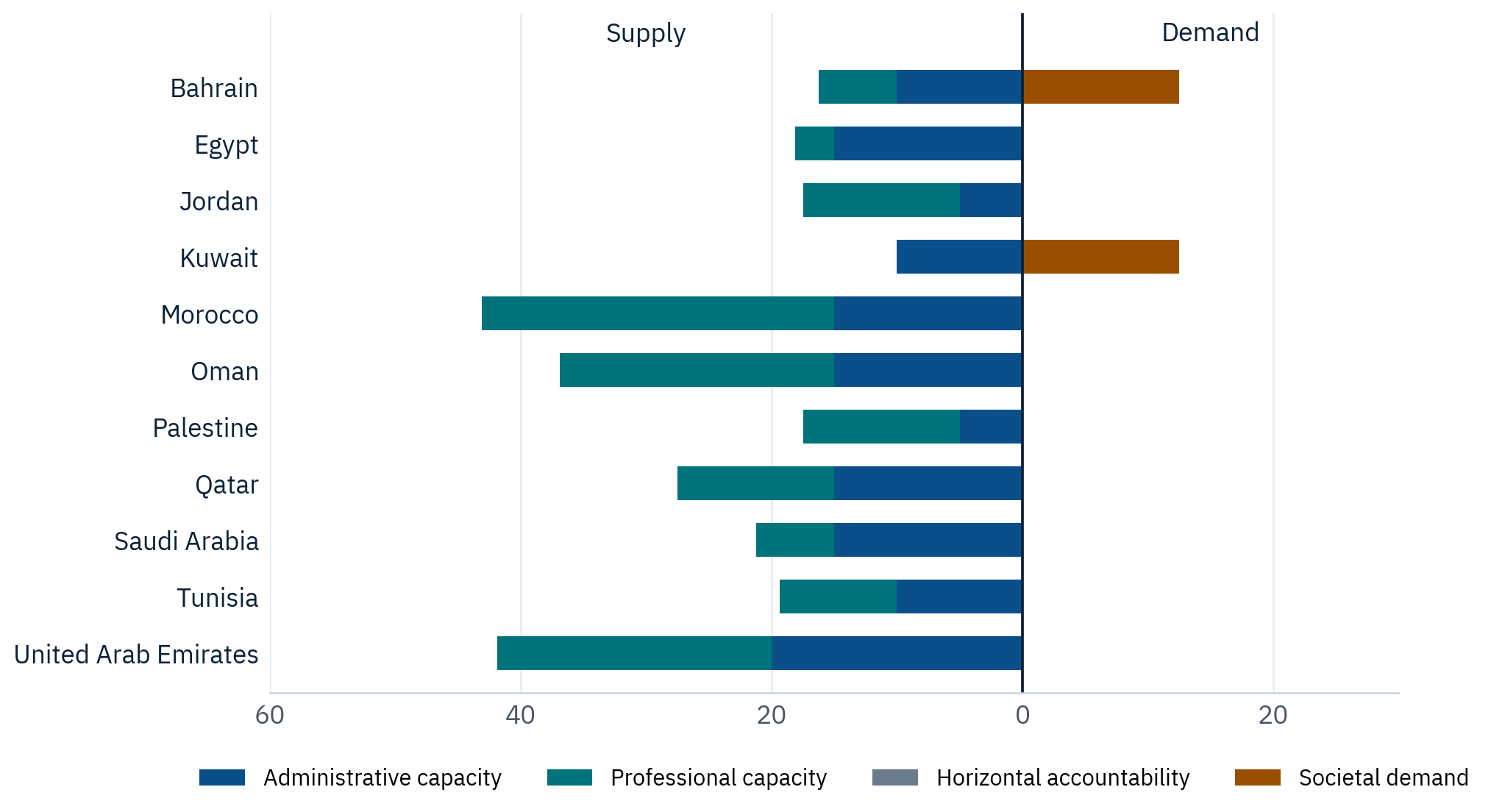
Supply and demand are regroupings of existing indicators, not a new index. Supply combines administrative capacity (laws, decrees, organisational embedding, sectoral spread and scope) and professional capacity (education, exchange, associations and norms). Demand combines horizontal accountability (the evaluation role of the supreme audit institution and parliamentary use) and societal demand (the five indicators of the social system). Supply exceeds demand in 10 of 11 states; in Kuwait societal demand exceeds supply. Horizontal accountability scores zero throughout the region.
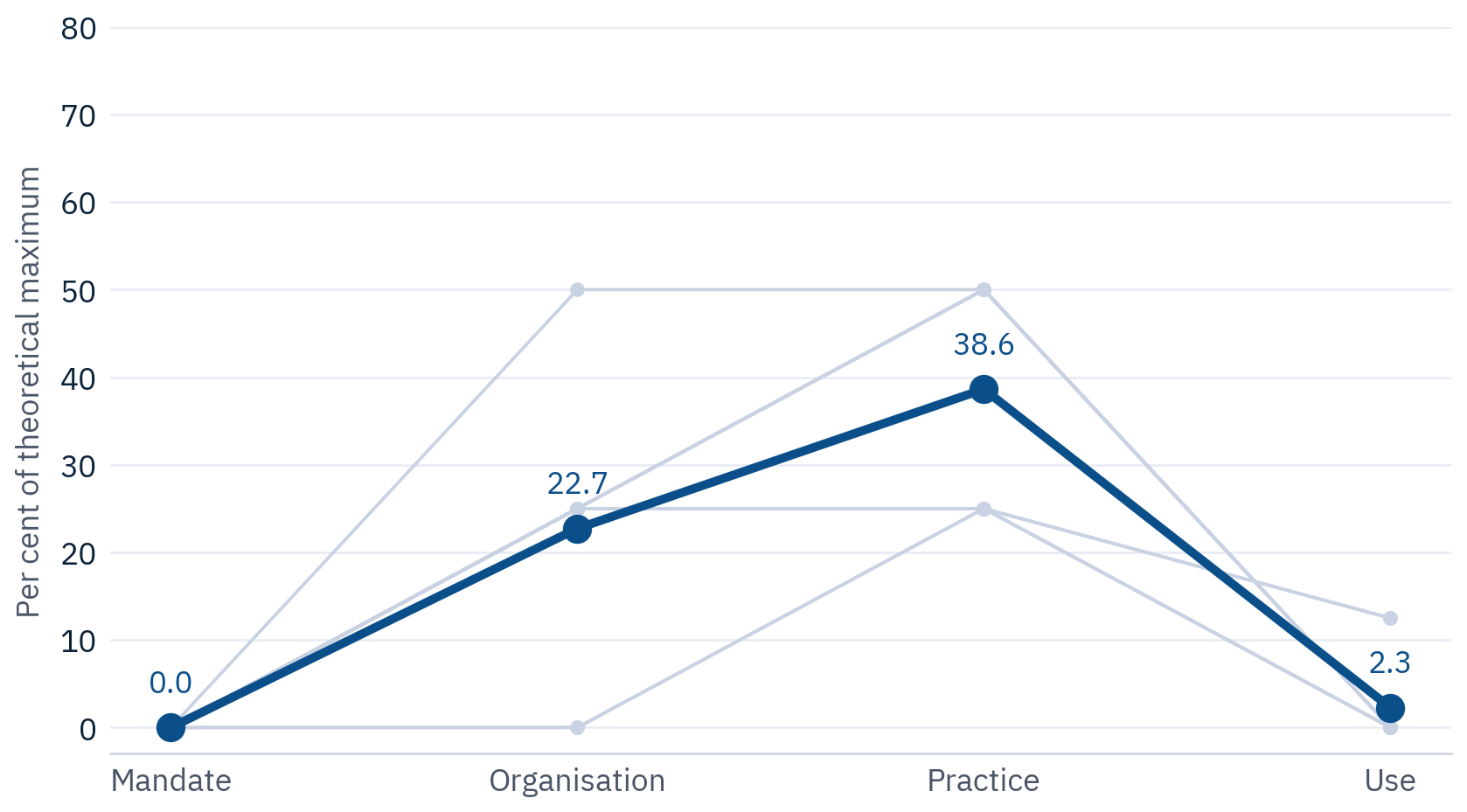
The administrative capacity pathway maps the indicators to four stages: mandate (laws and decrees), organisation (organisational embedding and the audit role), practice (sectoral spread and scope) and use (parliamentary and civil society use). The regional means trace the break: 0.0% for mandate, 22.7% for organisation, 38.6% for practice and 2.3% for use. Learning, the fifth stage in the sequence, is not measured by the index.
Two forms of decoupling follow. Organisational embedding exceeds formal anchoring in 9 of 11 states: evaluation units exist where binding rules do not. Routine practice exceeds governance use in 11 of 11 states: evaluation is carried out across sectors, but its findings do not enter audit, parliamentary or civic arenas.
The stages and their indicator mapping are the author’s for this edition. They reorganise the coded evidence; they do not add new data.
The supply–demand chart sets indicators of capacity to produce evaluation against indicators of demand for its use. Bars to the left measure supply, bars to the right demand. The absence of any right-hand bar in nine states is the principal finding.
Source: Ben Brik (2025), Index of Evaluation Institutionalization in the Arab Region, first edition. Framework: Evaluation GLOBE (Stockmann et al., 2020), used with permission.
The pathway traces the regional mean, and each state in grey, across the four stages from mandate to use. The line rises through organisation and practice and falls at use: evaluation is carried out, but its findings do not reach oversight.
Source: Ben Brik (2025), Index of Evaluation Institutionalization in the Arab Region, first edition. Framework: Evaluation GLOBE (Stockmann et al., 2020), used with permission.
6. Exploratory configurations
This chapter groups states by the similarity of their coded profiles. With eleven states, the groups are exploratory, not a regional classification.
Key messages
- Three configurations emerge from Ward clustering of the sixteen indicators.
- Morocco stands alone as a professionalised configuration.
- The two clustering bases agree on 33 of 55 state pairs.
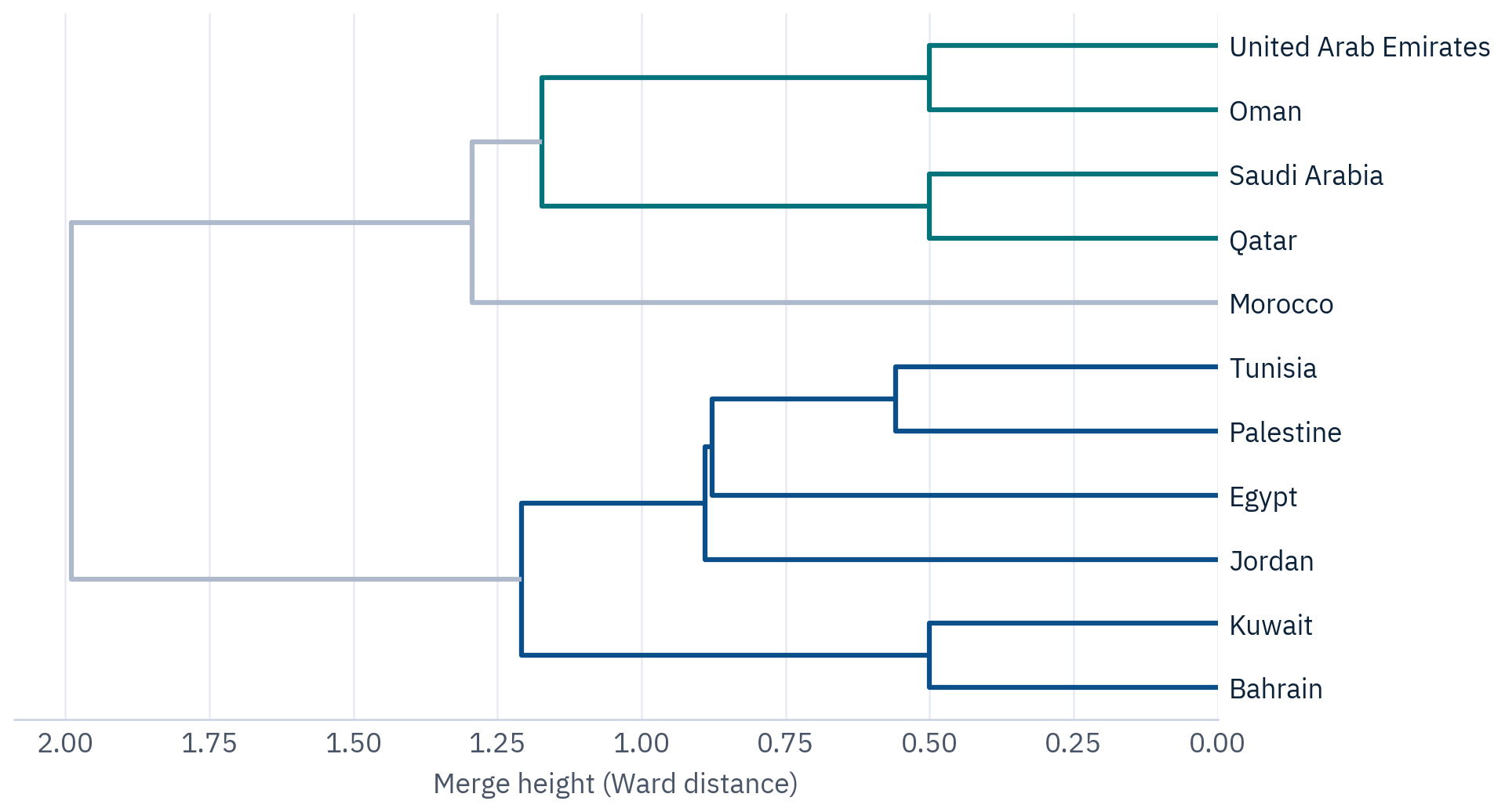
Hierarchical clustering with Ward linkage on the sixteen indicators groups the states into three configurations. Group 1 (Bahrain, Kuwait, Jordan, Palestine, Egypt and Tunisia) combines thin institutional bases in all three systems: political 14.0%, profession 14.6% and social 8.3% on average. Group 2 is Morocco alone, with the most professionalised system in the region (profession 56.2%, political 23.0%, social 0.0%). Group 3 (Qatar, Saudi Arabia, Oman and United Arab Emirates) combines organised executive systems with developing professional capacity (political 24.5%, profession 31.2%, social 0.0%).
The groups are sensitive to the clustering basis. At three groups, clustering on the sixteen indicators and on the four equally weighted sub-dimensions agrees on 33 of 55 state pairs. The five societal indicators move together, so the indicator basis weights the social system five times; the sub-dimension basis mirrors the equal weighting of the composite.
The configurations are therefore exploratory. They are useful as a way of reading similarity among states, not as a regional typology.
The dendrogram shows how states merge as similarity decreases. The height at which branches join measures the distance between configurations; the three coloured branches are the groups discussed in the text.
Source: Ben Brik (2025), Index of Evaluation Institutionalization in the Arab Region, first edition. Framework: Evaluation GLOBE (Stockmann et al., 2020), used with permission.
Table 63
Mean system scores by group
| Group | States | Political | Profession | Social |
|---|---|---|---|---|
| 1 | Bahrain, Kuwait, Jordan, Palestine, Egypt and Tunisia | 14.0% | 14.6% | 8.3% |
| 2 | Morocco | 23.0% | 56.2% | 0.0% |
| 3 | Qatar, Saudi Arabia, Oman and United Arab Emirates | 24.5% | 31.2% | 0.0% |
Note: per cent of the theoretical maximum.
Annex 1. Indicator coding scales
Table 60
Indicator statistics: mean, dispersion and diffusion
| Indicator | Sub-dimension | Mean | Standard deviation | States above zero |
|---|---|---|---|---|
| National evaluation laws and strategies | Institutional anchoring | 0.0 | 0.0 | 0 of 11 |
| National decrees on evaluation | Institutional anchoring | 0.0 | 0.0 | 0 of 11 |
| Organisational embedding | Institutional anchoring | 45.5 | 25.7 | 9 of 11 |
| Evaluation role of the supreme audit institution | Institutional anchoring | 0.0 | 0.0 | 0 of 11 |
| Parliamentary use of evaluation | Evaluation use | 0.0 | 0.0 | 0 of 11 |
| Sectoral spread of evaluation | Evaluation use | 50.0 | 0.0 | 11 of 11 |
| Scope of evaluation practice | Evaluation use | 27.3 | 24.9 | 6 of 11 |
| Use of evaluation by civil society | Societal system | 4.5 | 9.6 | 2 of 11 |
| Public knowledge of evaluation | Societal system | 4.5 | 9.6 | 2 of 11 |
| Media and public discourse | Societal system | 4.5 | 9.6 | 2 of 11 |
| Public availability of evaluation reports | Societal system | 4.5 | 9.6 | 2 of 11 |
| Civic demand for evaluation | Societal system | 4.5 | 9.6 | 2 of 11 |
| Academic education in evaluation | Professionalisation | 54.5 | 39.6 | 8 of 11 |
| Professional communication and exchange | Professionalisation | 29.5 | 29.8 | 7 of 11 |
| Organisation of the profession (VOPEs) | Professionalisation | 13.6 | 28.9 | 3 of 11 |
| Professional norms and standards | Professionalisation | 0.0 | 0.0 | 0 of 11 |
Note. Means and population standard deviations in percentage points across the 11 states.
Reading the table
Indicators with a mean of zero and no dispersion carry no discriminating information in this edition but identify the priorities of evaluation policy. Discriminating indicators are concentrated in the profession system.
Annex 2. Complete indicator data
Table 61
Complete indicator data
| State | 1A·1 | 1A·2 | 1A·3 | 1A·4 | 1B·1 | 1B·2 | 1B·3 | 2A·1 | 2A·2 | 2A·3 | 2A·4 | 2A·5 | 3A·1 | 3A·2 | 3A·3 | 3A·4 |
|---|---|---|---|---|---|---|---|---|---|---|---|---|---|---|---|---|
| Morocco | 0 | 0 | 0.5 | 0 | 0 | 0.5 | 0.5 | 0 | 0 | 0 | 0 | 0 | 1 | 0.25 | 1 | 0 |
| United Arab Emirates | 0 | 0 | 1 | 0 | 0 | 0.5 | 0.5 | 0 | 0 | 0 | 0 | 0 | 1 | 0.75 | 0 | 0 |
| Oman | 0 | 0 | 0.5 | 0 | 0 | 0.5 | 0.5 | 0 | 0 | 0 | 0 | 0 | 1 | 0.75 | 0 | 0 |
| Qatar | 0 | 0 | 0.5 | 0 | 0 | 0.5 | 0.5 | 0 | 0 | 0 | 0 | 0 | 1 | 0 | 0 | 0 |
| Bahrain | 0 | 0 | 0.5 | 0 | 0 | 0.5 | 0 | 0.25 | 0.25 | 0.25 | 0.25 | 0.25 | 0.5 | 0 | 0 | 0 |
| Saudi Arabia | 0 | 0 | 0.5 | 0 | 0 | 0.5 | 0.5 | 0 | 0 | 0 | 0 | 0 | 0.5 | 0 | 0 | 0 |
| Kuwait | 0 | 0 | 0.5 | 0 | 0 | 0.5 | 0 | 0.25 | 0.25 | 0.25 | 0.25 | 0.25 | 0 | 0 | 0 | 0 |
| Egypt | 0 | 0 | 0.5 | 0 | 0 | 0.5 | 0.5 | 0 | 0 | 0 | 0 | 0 | 0 | 0.25 | 0 | 0 |
| Tunisia | 0 | 0 | 0.5 | 0 | 0 | 0.5 | 0 | 0 | 0 | 0 | 0 | 0 | 0.5 | 0.25 | 0 | 0 |
| Jordan | 0 | 0 | 0 | 0 | 0 | 0.5 | 0 | 0 | 0 | 0 | 0 | 0 | 0 | 0.75 | 0.25 | 0 |
| Palestine | 0 | 0 | 0 | 0 | 0 | 0.5 | 0 | 0 | 0 | 0 | 0 | 0 | 0.5 | 0.25 | 0.25 | 0 |
Source: Ben Brik (2025), Index of Evaluation Institutionalization in the Arab Region, first edition.
References
- Ben Brik, A. (2025). The institutionalization of evaluation in the Middle East and North Africa. Edward Elgar Publishing. https://doi.org/10.4337/9781035359820
- Ben Brik, A. (Ed.). (2025). Public policy evaluation in the Middle East and North Africa. Bristol University Press. https://doi.org/10.46692/9781447375708
- DiMaggio, P. J., & Powell, W. W. (1983). The iron cage revisited: Institutional isomorphism and collective rationality in organizational fields. American Sociological Review, 48(2), 147–160.
- Furubo, J.-E., Rist, R. C., & Sandahl, R. (Eds.). (2002). International atlas of evaluation. Transaction Publishers.
- Jacob, S., Speer, S., & Furubo, J.-E. (2015). The institutionalization of evaluation matters: Updating the International Atlas of Evaluation 10 years later. Evaluation, 21(1), 6–31.
- Leeuw, F. L., & Furubo, J.-E. (2008). Evaluation systems: What are they and why study them? Evaluation, 14(2), 157–169.
- Meyer, J. W., & Rowan, B. (1977). Institutionalized organizations: Formal structure as myth and ceremony. American Journal of Sociology, 83(2), 340–363.
- Pritchett, L., Woolcock, M., & Andrews, M. (2013). Looking like a state: Techniques of persistent failure in state capability for implementation. Journal of Development Studies, 49(1), 1–18.
- Stockmann, R., Meyer, W., & Taube, L. (Eds.). (2020). The institutionalisation of evaluation in Asia-Pacific. Palgrave Macmillan.
- Weiss, C. H. (1998). Have we learned anything new about the use of evaluation? American Journal of Evaluation, 19(1), 21–33.